The Fringe Benefit Tax (FBT) rules for motor vehicles are having a huge overhaul. So if you own a company car or ute, there are some things you need to know before the changes come in on 1 April 2027.
The changes will be good news for some business owners, make no difference at all to others, and unfortunately for some ute owners it might end up costing more.
And if you’re a sole trader? These changes don’t impact you at all, so you can stop reading here and get an extra 5 minutes back in your day.
Why the change?
The aim is to simplify some very complex and misunderstood rules around private use of motor vehicles and whether various exemptions like the work-related vehicle and emergency call-out exemptions actually apply.
What’s changing and how might it affect you?
The biggest change is that the amount of Fringe Benefit Tax you pay will be based on how the vehicle is actually used.
Do you use your vehicle 90% for work with the odd stop to pick up groceries on the way home; or
Are you mostly office based and use your company car for commuting and on weekends; or
Something in between?
Essentially much you use your company vehicle for personal use will determine which of the new FBT categories your vehicle falls into. That category in turn determines how much of the vehicle’s cost is used to calculate FBT. This is called the “FBT Inclusion Rate”.
The new categories are:
| | FBT |
|---|---|---|
1. | Mainly for private use. | 100% |
2. | Mainly for business use with partial private use. | 35% |
3. | Mainly for business use on farmland. | 35% |
4. | Mainly for business use with minor private use. | 20% |
5. | For business use. | 0% |
6. | Pool car with no private use. | 0% |
Other things to know
The work-related vehicle exemption is removed – utes don’t get special exemptions from FBT. Instead all vehicles will fall into one of the categories above, based on how they are used.
Branding is mandatory if the vehicle fits into categories 2-5. There are a few exceptions here, for example, where the nature of the business is sensitive.
Incidental or occasional personal use is OK. That means if you stop at the supermarket on your way home or use the company ute one weekend to move house, that’s allowed.
While we might consider the weekend starts at 5pm on a Friday, if you work on a Friday it that counts as a workday.
Employee contributions can still be used to reduce the amount of FBT payable. This includes the motor vehicle reimbursement by shareholder employees which is commonly used by Trio Accounting so that you don’t need to register to pay FBT.
What this looks like in real life
Let’s take a look at some scenarios likely to affect small business owners.
Meet Sarah…
Sarah owns an architectural design company. She has a $40,000 SUV which she drives to and from her offices in Wellington and Lower Hutt and out to clients for site visits and to supplier showrooms.
Scenario 1: Unlimited private use (Category 1)
Sarah uses the car before and after work to pick up/drop off her kids and take them to various after-school activities. She also uses the car to go to the gym and netball practice during the week. The weekend is spent ferrying kids to their various sports and running errands.
Because Sarah is using the car during the working week for personal travel her vehicle falls into Category 1. This applies even though more than 50% of her mileage is for work. FBT is worked out on the full $40,000 value of her vehicle.
Scenario 2: Some private use (Category 2)
Sarah’s partner does the school run most days and all the after-school activities. Sarah occasionally drops the kids off at school as it’s right on her route to the office. She uses her work car on the weekend, but during the week she uses the family car to go to the gym and netball practice.
Because Sarah only uses her company car for incidental personal travel during the week, but does use it personally on the weekend, the car falls into Category 2. FBT is worked out on 35% of the value of her vehicle which equates to $14,000, not the full $40,000.
Scenario 3: Business use (Category 5)
Sarah travels to one or other of her offices or directly out to her clients’ homes. She doesn’t use the car personally at any other time apart from the odd time when she drops the kids off at school or picks up groceries on the way home. They have a family car which she uses for all her personal trips.
Because she is travelling to multiple work locations and doesn’t use her car personally at any other time beyond incidental/occasional use, the car falls into Category 5. There is no FBT payable.
So the same business, same $40,000 car but the amount of FBT payable will be worked out on a vehicle value of $40,000, $14,000 or $0 based on how the vehicle is actually used.
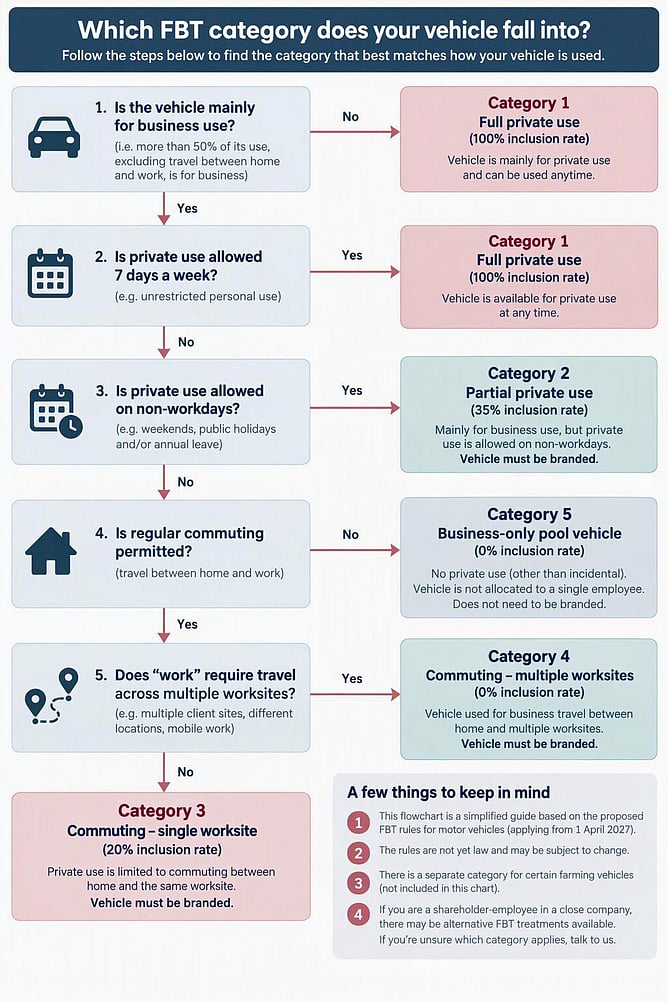
Not sure where you fit? Our flowchart below will help.
Next steps
Decide which category your vehicle falls into using the flowchart above. If you use your car personally for anything more than incidental travel on a work day then it’s automatically Category 1.
Get your branding sorted if your vehicle fits into categories 2-5. Remember to keep the signwriting consistent with the rest of your branding.
Keep a logbook for the next three months - this will help confirm if your travel is mainly for work and whether you use it personally during the week or on weekends or annual leave. Record every trip and categorise it into the following categories:
Commuting – travel between home/work
Business
Personal
Update your documentation - even if you are a shareholder employee, we recommend having a letter from you as a director to you as the shareholder employee outlining how/when the vehicle is allowed to be used.
Some minor alterations are still possible before the bill is passed by parliament, but it’s unlikely the key changes outlined above will be affected.
These changes are significant and a completely new way of thinking about personal use of company vehicles. We’re here to help you navigate the switch and will be working with our clients ahead of 1 April 2027 to make sure everything is in order. If you’d like us to check where your vehicle fits, please just get in touch.